Forex for beginners: a practical start path from first chart to first trade
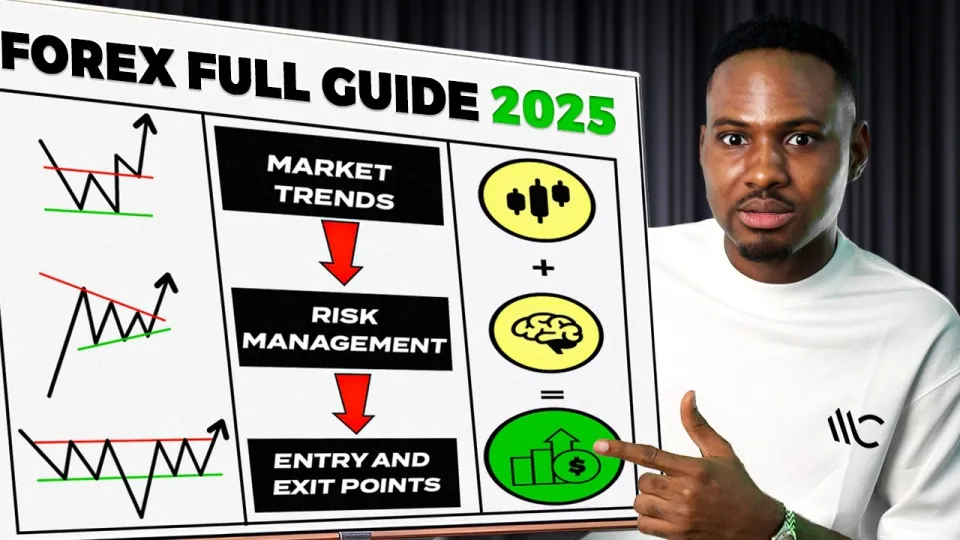
Video: How To Start Forex Trading For Beginners’ 2025 (Full Course)
Want articles like this for your own video to promote it on YouTube and Google? Order them through the Telegram bot @sat_sit_bot. It writes articles around your video, embeds the video and publishes them on popular niche websites (no ads). Try it free: 50 articles on us.
Forex is the trading of one currency against another on an over-the-counter market, and a beginner starts by opening a broker account, installing a platform such as MT5, practising on a demo, and risking no more than 1–2% of the account per trade. That is the whole starting sequence in one sentence; everything else is detail you add on top of it. A structured walkthrough of this path is exactly what the full beginner course from Jeffrey Benson Forex covers, and the author's own student page is here: FirePips FX plans and course access.
What forex trading actually is and why currencies move
Forex is the market where the price of one currency is expressed in another, which is why everything is quoted in pairs. When you see EUR/USD at 1.0850, one euro buys 1.0850 US dollars, and a trader who expects the euro to strengthen buys the pair; a trader who expects it to weaken sells it. There is no central exchange: banks, brokers and liquidity providers quote prices to each other, and retail traders reach that flow through a broker.
Prices move because of interest rates, inflation data, employment reports, central-bank decisions and capital flows between economies. A currency strengthens when demand for it rises, and demand rises when holding that currency pays more or looks safer. This is why the calendar matters as much as the chart: a rate decision or a non-farm payrolls release can move a major pair more in five minutes than it moved in the previous five hours.
Three terms cover most of the vocabulary a beginner needs:
- Base and quote currency — in GBP/USD, the pound is the base and the dollar is the quote.
- Pip — the standard smallest price step, usually the fourth decimal place, so 0.0001 on most pairs and 0.01 on yen pairs.
- Spread — the gap between bid and ask, which is the broker's built-in cost of every trade.
How the forex market works during the trading day
Forex trades 24 hours a day, five days a week, and the day is divided into four sessions — Sydney, Tokyo, London and New York — that overlap at specific hours. Liquidity and volatility are not constant: the London–New York overlap is the busiest window for EUR/USD and GBP/USD, while the late New York session and the Sydney open are usually quieter. Beginners who trade a pair during its own session get tighter spreads and cleaner moves than those who trade the same pair at 3 a.m. local time.
Order types are the second half of how the market works. A market order fills immediately at the current price; a limit order waits for a better price; a stop order triggers once price passes a level. On top of that sits leverage — the ability to control a position larger than your deposit. At 1:100 leverage, a 1,000-dollar margin controls a 100,000-dollar position, which means a 1% move in the pair changes the account by roughly 1,000 dollars in either direction. Leverage does not create profit; it only scales the result of a decision that was already right or wrong.
Tools a beginner needs before the first trade
The minimum toolkit is short: a regulated broker account, a trading platform, a demo account, an economic calendar and a journal. MetaTrader 5 (MT5) is the platform most beginner courses, including this one, build around, because it combines charting, order execution and a built-in strategy tester on desktop and mobile.
A practical setup order looks like this:
- Choose a broker regulated by a recognised authority, and check spreads, commissions and withdrawal terms before depositing.
- Open a demo account first and keep it for at least a few weeks of consistent trading.
- Build a chart template on MT5 with a clean layout: one higher timeframe for direction, one lower timeframe for entries.
- Add an economic calendar and a position-size calculator.
- Start a journal with columns for date, pair, session, setup, risk, result and the reason for entering.
A notebook or spreadsheet is not a formality. Traders who write their trades down discover within a month which setups actually work for them, while traders who rely on memory repeat the same three mistakes indefinitely.
Building a basic strategy foundation
A strategy is a written rule set for when to enter, where to exit and how much to risk, and a beginner needs only one such rule set to start. Most beginner frameworks combine a directional bias from a higher timeframe with a trigger on a lower one. For example: if price on the four-hour chart is making higher highs and higher lows, look for buys on the fifteen-minute chart after a pullback into a moving average or a previous support zone.
Three components make the framework usable:
- Entry condition — the specific pattern or level that must appear, described so precisely that you could hand it to another person.
- Stop loss — placed at the level that would prove the idea wrong, not at a round number chosen for comfort.
- Take profit — a target at least as large as the risk, so a 1:2 risk-to-reward ratio keeps the strategy profitable at a win rate under 50%.
Risk management is the part that decides survival. With 1% risk per trade, ten consecutive losses cost about 10% of the account, which is recoverable; with 10% risk per trade, the same streak cuts the account by roughly two-thirds. Position size follows from that number: risk in money divided by stop distance in pips gives the lot size. This single calculation is what most beginners skip, and it is the one the audience of the source course repeatedly names as the moment things clicked.
Placing the first trade and reviewing it
The first live trade should be small enough that the outcome is emotionally irrelevant, because its purpose is to test the process, not to make money. On MT5 the sequence is: open the pair's chart, set the lot size from your risk calculation, choose market or pending order, attach the stop loss and take profit in the order ticket, and confirm. Then screenshot the chart before and after, and log the trade in the journal with the reason for entry.
Review comes after, not during. Once the trade closes, compare what you planned with what you did: was the entry per the rules, was the stop where the plan said, did you move it under pressure? Three honest reviews teach more than thirty trades taken without notes. A demo account is the right place to run this loop until the rules are followed without hesitation.
Common beginner mistakes and open questions
Most beginner losses come from process failures rather than bad analysis, and the same handful of errors repeats across every forum thread on the topic. Overleveraging tops the list: a position too large for the account turns a normal pullback into a margin call. Next is trading without a stop loss, or moving the stop further away to avoid being taken out. Third is revenge trading after a loss, which turns one controlled risk into an uncontrolled sequence.
Other frequent problems: trading during major news without accounting for spread widening, switching strategies after two losing trades, following signal groups without understanding the entries, and treating a demo account casually so that it teaches nothing. A related doubt beginners raise is whether they need years of study — the honest answer is that the mechanics take days, while consistent execution takes months of deliberate practice.
Useful links
- FirePips FX plans and student access — the author's course and mentorship page.
- https://t.me/firepipsignals — free daily signal channel referenced in the course.
- https://my.assexmarkets.com/auth/register?partner_code=1699134 — broker registration link used in the walkthrough.
- https://t.me/jeffreybenzhelpbot — bot for the premium signal group.
Bottom line
Forex for beginners is a sequence, not a secret: understand the pair and the session, set up a regulated broker and MT5, write one rule-based strategy, size every position from a fixed 1–2% risk, and journal each trade. The full course from the Jeffrey Benson Forex channel is a useful companion because it walks that same order from market basics to a first live trade and the mistakes to avoid. Start on demo, keep the first live position small, and let the journal — not the profit and loss — tell you when you are ready to scale. If you want the structured version with mentorship, the FirePips FX plans page is the place to begin.
Key takeaways
- Forex is an over-the-counter market where currencies are traded in pairs such as EUR/USD; there is no single exchange, and access goes through a broker.
- The market runs 24 hours a day, five days a week, split into four sessions: Sydney, Tokyo, London and New York.
- A standard lot is 100,000 units of the base currency; leverage lets you open a position with a fraction of that value, but it magnifies losses as well as gains.
- The standard beginner toolkit is a broker account, the MT5 platform, a demo account and a trading journal.
- Risk per trade of 1–2% of the account is the most common rule taught to new traders, and it matters more than the entry strategy.
Source: How To Start Forex Trading For Beginners’ 2025 (Full Course) · Markdown version
Questions & answers
How much money do I need to start forex trading?
There is no fixed minimum, but the account size must be large enough that a 1–2% risk per trade is a meaningful but survivable amount. Many beginners start on a demo account and then fund a small live account, treating the first deposit as tuition rather than capital. The key constraint is position sizing, not the deposit itself.
How long does it take to become consistently profitable?
The mechanics — orders, stops, lot sizing — can be learned in a few days, but consistent execution usually takes months of deliberate practice with a journal. Traders who skip the review stage tend to repeat the same errors for far longer. Treat profitability as a by-product of a repeatable process rather than a deadline.
Is a demo account enough, or do I need real money to learn?
A demo is the right place to learn the platform and test rules without financial pressure, but it does not reproduce the emotional weight of real money. The usual path is a few weeks of disciplined demo trading followed by a small live account. Keep the first live position small enough that the result does not affect your decisions.
Can I copy someone else's trades instead of learning to trade?
Copying signals is possible and some courses offer it, but it leaves you unable to judge the risk behind each entry or to manage the position when something goes wrong. It works best as a supplement to learning, not a replacement. Understanding position sizing and stop placement is what protects the account in either case.